
What Is Microcement? What It Is Made Of, Where It Works and Where It Fails

What is microcement made of?
A conventional microcement has four ingredients: cement, a fine aggregate such as sand, a water-based resin (the polymer) and pigment. The cement hardens and gives the coating its mineral look. The polymer helps it grip the surface below and gives it a little flexibility, and the pigment sets the color.
Some brands ship it in two parts, a dry powder and a separate liquid polymer, which are combined on the job. Others sell a single component that only needs water or pigment. That is a packaging choice and does not change the material.
The word itself is not a specification, though. Suppliers now sell three different chemistries as microcement: acrylic-cement, epoxy-modified and polyurethane with a mineral aggregate. They flex, hold color and handle water differently. The only reliable way to know which one you are buying is the product’s technical data sheet, which names the binder in each layer.
The names overlap in the other direction too. One product can be sold as microcement, microtopping and skim coat at the same time. If you are trying to work out whether those are different materials, our guide to microcement vs microtopping answers it.
Where you can use microcement, including over tile
Microcement is used on interior floors, walls, ceilings, stairs, kitchen countertops and built-in furniture. Many systems are also sold for bathrooms, showers, outdoor surfaces and pools. Each of those uses needs a system approved for it, though. A product that works on a dry living-room wall is not automatically approved for a shower floor. One rated for interior concrete is not automatically rated for a patio.
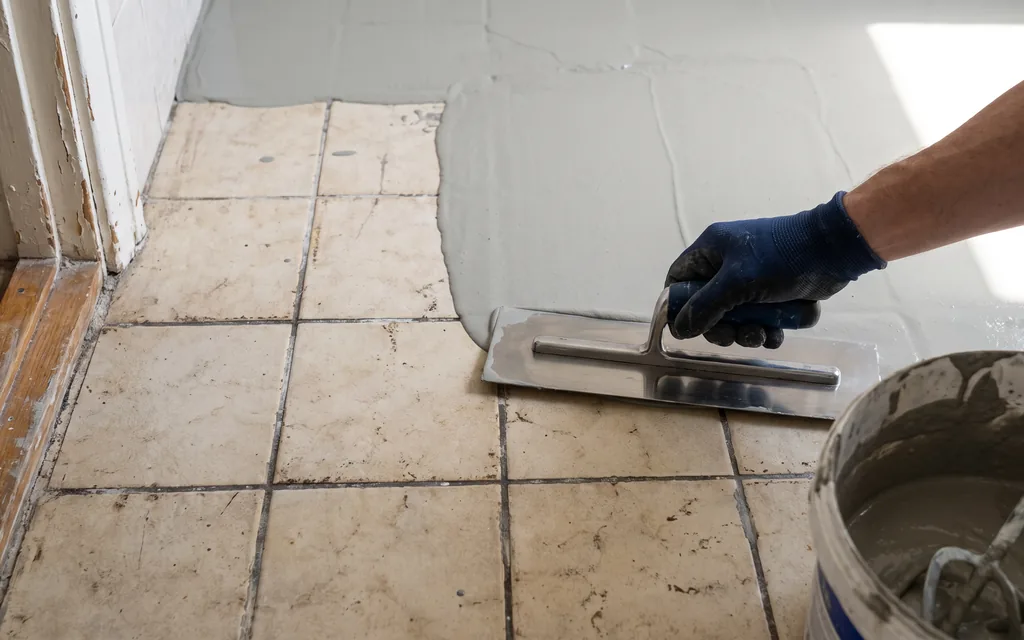
The usual substrates are concrete, cement board, plaster, drywall and ceramic tile. Covering old tile is one of the main reasons people look at microcement, and it works when the tiles are firmly bonded, clean and flat. Loose or hollow-sounding tiles have to come out first because the coating cannot hold down a tile that has already let go. The grout joints are filled and the glazed surface is primed so the first coat can grip. Skip the joint filling and the grout pattern can show through the finish.
A wood subfloor moves, so it is covered with a rigid board before any coating goes on. Bare metal also has to be clad, usually with cement board, before it can be coated.
In a shower, the coating you see is not what keeps the water out. A bonded membrane meeting ANSI A118.10 is built into the walls and floor before the coating. We explain how that layering works in is microtopping waterproof. For the wider choice of finish in a bathroom, read microcement bathroom pros and cons.
How a microcement floor or wall is installed
Installation starts with the substrate, which must be solid, clean, flat and dry before the first coat.
On a concrete slab, test for moisture first. Two ASTM tests are used. F1869 measures how much moisture vapor the slab gives off, with a dish of calcium chloride sealed under a dome. F2170 reads the relative humidity inside the slab with probes. Each manufacturer sets its own pass mark. One US system, for example, asks for less than 3 lb per 1,000 sq ft in 24 hours on the first test and less than 80% relative humidity on the second. Above those figures, a moisture-mitigation system goes down first.
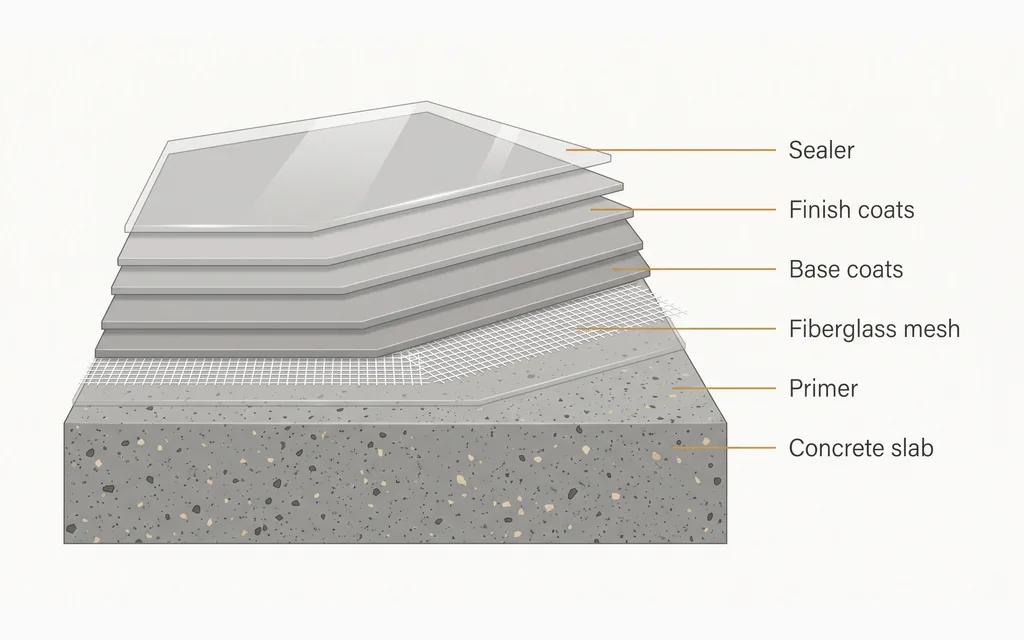
The surface is then ground or cleaned, cracks are repaired, and a primer goes on to control absorption and give the coating something to grip. Where the substrate is likely to move, fiberglass mesh is set into the first coat. The reasons are in our guide to fiberglass mesh for microcement.
The coats themselves are thin. One US system goes on in two coats of about 1/32 inch each, while others use two base coats and two finish coats. The installer trowels each coat and lets it dry before the next. The sealer coats come last: they decide the sheen and keep water and stains out of the surface.
Two details often trip people up. First, a jointless look does not mean the joints are gone. Expansion and control joints in the slab still have to be carried up through the finish, or the coating will crack along them. Second, grinding and mixing cement-based products produces respirable crystalline silica, the dust covered by OSHA’s construction standard 29 CFR 1926.1153. On a professional job, that standard sets the dust controls and the respiratory protection.
What microcement cannot do
Most of the disappointment with microcement comes from expecting it to do a job it was never designed for. The table below sets the common expectations against what the material actually does.
You may hear | What holds in practice |
It goes over anything | It goes over a sound, flat, stable surface. It follows dips and waves, so leveling is a separate step |
It doesn’t crack | A cement-based coating mirrors cracks and movement in the substrate. Preparation and mesh reduce that risk, and our microcement cracking guide explains the causes |
It is waterproof | The sealer resists water, but it is not a membrane |
It needs no maintenance | It needs a pH-neutral cleaner and a sealer that is renewed as it wears |
Every microcement is the same | Cement, epoxy and polyurethane products are all sold under the name, and they perform differently |
Two more limits show up during the job itself. Color can shift while a cement-based coating cures because the cement keeps reacting as the water leaves. And because each coat is troweled by hand, lap lines can show where one pass dries against the next.
We know these problems from our own work. From 2009 we spent nine years applying cement-based systems, and the failures we kept meeting were hairline cracks, lap lines and trouble in wet areas.
Alternatives to microcement, including a cement-free resin system
The common alternatives each solve a different problem. Tile is the familiar choice for wet areas, but it brings back the grout lines. Polished concrete grinds and densifies an existing slab. It suits a slab in good condition that you are happy to see, marks and joints included. An epoxy floor coating is a separate category, and we compare it in microtopping vs epoxy.
The fourth alternative is a different material that gives a similar look. In 2018 we introduced TERRAZZO GraniTech in response to what we kept seeing on those jobs. It is a cement-free resin microtopping made from natural granite aggregate in an acrylic resin. It goes on in thin coats with a trowel, with no cement anywhere in the mix.
Its patented anti-crack memory resin technology removes the shrinkage cracking and crazing that a rigid cement coating develops as it cures. It does not stop a substrate that moves, so preparation and mesh still do that job, exactly as they would under a cement product. It is a waterproof decorative finish, but it is not a waterproofing membrane, and a shower still gets one underneath.
The material comes as a premixed, single-component paste, so there are no bags and liquids to batch on site. It has a long working time and leaves no lap lines between passes. An opened bucket, resealed, stays usable for up to 12 months, and a damaged area can be repaired in place. It is UV-stable, so it also works outdoors, and it is low in VOCs. It should not be applied below about 54°F (12°C). When the surface is prepared correctly, concrete, cement board, drywall and existing tile can all take it where they are: no demolition, no hassle, no permits. Our product submittal lists R11 slip resistance with footwear (DIN 51130) and Class B barefoot (DIN 51097).

It comes in three core finishes. Fine and Medium differ in texture, and Microterrazzo carries fine embedded stone aggregate for a terrazzo look without pouring a slab.
Our network of trained installers carries out the projects, and you can find one through Application Services. Contractors who want to apply the system themselves learn it hands-on in our 3-day seminars. Any workmanship warranty is the installer’s to give. For how the system behaves on real jobs, see Why TERRAZZO GraniTech.
Frequently asked questions
How do I choose the right microcement for my project?
Start with the technical data sheet: it should name the binder, the substrates the product is approved for and the system required for wet areas. Then ask the installer which primer and sealer they will use with it because the coating only performs as part of that full system.
How durable is microcement when applied over tiles?
It generally lasts as long as the tile bond underneath it. Over firmly bonded, primed tile it performs as it would on any other sound surface. A tile that later loosens can crack the finish above it.
How long does microcement last?
A lifespan quoted on its own means little. The preparation, the traffic and how often the sealer is renewed decide how long a given floor holds up.
Is epoxy microcement the same as regular microcement?
No. Epoxy microcement binds its aggregate with an epoxy resin instead of an acrylic-modified cement.
Is microcement better than epoxy flooring?
They do different jobs. Epoxy is harder and more chemical-resistant, but epoxy topcoats tend to yellow in sunlight. Microcement is chosen for a decorative finish that can also run up the walls.
Can I install microcement myself?
It depends on the product. Some data sheets restrict use to trained professionals and others are sold to DIYers. Showers, large floors and slabs with moisture problems are best left to a trained installer.