
Understanding Common Epoxy Resin Problems and Why They Happen
Epoxy projects fail for straightforward reasons once you understand the chemistry and environmental factors at play. This section breaks down how the curing process works, how materials and conditions interact, and why minor technique variations produce dramatically different outcomes.

Overview of the Epoxy Curing Process
The curing process transforms liquid components into solid polymer through cross-linking, requiring precise conditions for success. When you blend resin and hardener correctly and mix thoroughly, polymer chains form and connect to create the rigid, glossy surface epoxy is known for.
Poor mixing, incorrect ratios, or inadequate scraping leave unmixed pockets that prevent proper curing, creating soft spots or tacky sections. Standard guidance calls for two to five minutes of continuous stirring while scraping all surfaces multiple times. When a layer feels tacky after the recommended cure time, you’re dealing with incomplete polymerization from mixing errors.
How Resin and Hardener Chemistry Affects Results
Different epoxy systems use varying ratios like 1:1, 2:1, or 3:1 by weight or volume, and using the manufacturer’s hardener ensures correct catalysts and additives. Substituting different hardeners, adding too much or too little, or failing to measure accurately creates chemical imbalances that cause incomplete cure, weakness, or discoloration.
Properly balanced systems cure to predictable hardness and clarity, but disrupted chemistry produces brittleness causing cracks, excessive softness, or rapid yellowing. Manufacturers with detailed technical data sheets make it easier to match components correctly.
Role of Temperature, Humidity, and Environment
Temperature and humidity directly control cure speed and finish quality, with most epoxies performing best at 70-80°F. Dropping from 77°F to 59°F roughly doubles cure times and increases tackiness risk.
Humidity above 60% or moisture contact causes cloudiness, haziness, or amine blush during curing. Rapid temperature changes create uneven curing and internal stress, leading to crazing or cracking. A stable workspace with moderate heat, low humidity, and draft protection reduces these risks substantially.
Why Product Quality and Proper Storage Matter
Unopened epoxy typically lasts about one year when stored cool and dry, but once opened, the usable lifespan often drops to a few months as oxidation and moisture absorption degrade the chemistry. Hardeners may darken with age while losing reactivity.
Buying from reputable manufacturers, storing containers upright and sealed, and keeping materials from sunlight extends reliable performance. Proper storage preserves mixing behavior and curing characteristics.
| Faktor | Effect on Curing | Practical Tip |
| Mix Ratio | Directly controls reaction rate, final hardness, and optical clarity | Follow manufacturer ratio exactly using a precise digital scale rather than estimating |
| Mix Technique | Inadequate mixing leaves unmixed pockets that prevent complete polymerization | Mix for 2-5 minutes minimum while thoroughly scraping sides and bottom multiple times |
| Temperatur | Lower temperatures dramatically slow cure times while excessive heat accelerates exothermic reactions | Maintain workspace near 75°F and warm resin bottles in lukewarm water before mixing if needed |
| Luftfeuchtigkeit | Elevated humidity causes cloudiness, surface defects, and amine blush formation | Keep relative humidity below 60% during entire cure cycle using dehumidifier if necessary |
| Storage Conditions | Degraded components alter cure performance and reduce usable shelf life | Store sealed containers upright in cool, dark location away from sunlight and heat |
| Component Compatibility | Mismatched resin and hardener systems change cure profile and final properties | Always use the specific hardener supplied or recommended by resin manufacturer |
| Pour Thickness | Excessively thick applications generate dangerous heat buildup and cracking | Follow manufacturer’s maximum pour depth and build up thickness through multiple thin layers |

Air Bubbles and Trapped Air: Causes, Prevention, and Fixes
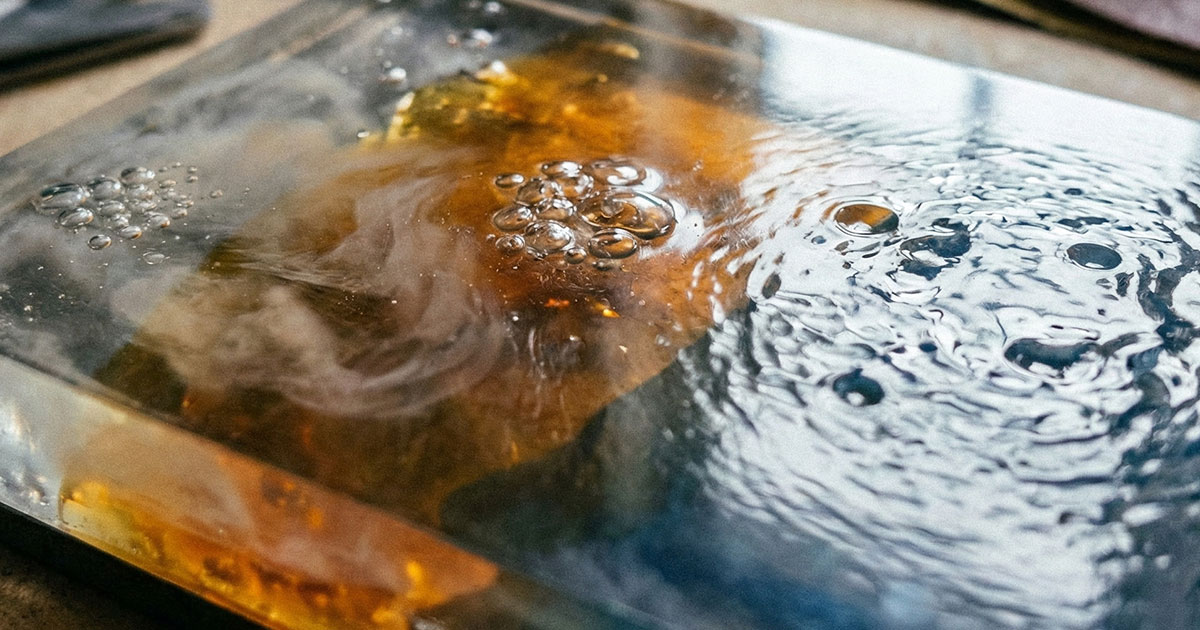
Klein air pockets trapped in cured epoxy ruin clarity and create weak points. Porous materials like oak, paper, and fiberglass contain tiny air pockets, and when resin flows over them, liquid pressure forces trapped air upward where it forms visible bubbles if the resin is too thick, cold, or applied too quickly.
Improper mixing represents the second major source, particularly when stirring too aggressively, creating vortexes, or using power tools at excessive speeds. Even careful pouring locks microbubbles into place if the resin is cold and viscous.
How Pores and Mixing Introduce Bubbles
Wood grain and woven textiles act like sponges filled with trapped air. When you flood these surfaces, that air migrates upward through the liquid but can remain suspended if you apply thick coats too quickly or work with cold resin. Mixing with clean, flat stir sticks using slow, steady motions dramatically reduces whipped-in air compared to rapid stirring.
Best Practices to Prevent Bubbles
Apply a thin seal coat on porous substrates as the most effective prevention method, forcing air from surface pores while creating a sealed foundation. Warming resin bottles gently in water baths below 95°F reduces viscosity, allowing bubbles to rise and escape faster.
Pour from a few inches above the surface rather than directly against it to minimize turbulence. Use deliberate scraping motions that fold materials together rather than whipping them, and pause to scrape container sides and bottom thoroughly.

Tools for Air Bubble Removal
Running a heat gun or propane torch lightly across freshly poured surfaces breaks surface tension holding bubbles down, causing immediate release. Keep heat sources moving constantly at safe distances to prevent scorching or yellowing.
For persistent microbubbles or large batches, vacuum chambers provide thorough degassing by removing dissolved air before pouring, especially helpful for deep pours where surface torching isn’t practical.
When Repairs Require Sanding
Bubbles that cure into hardened surfaces require mechanical removal through sanding, starting with coarse grits to level areas and progressing to finer grits before cleaning and applying fresh compatible resin. Properly prepared surfaces accept new layers and restore optical clarity.
Severe bubble problems throughout thick castings typically justify complete removal and recasting since deeply embedded bubbles can’t be reached through sanding.

Cloudy or Hazy Resin Surface: Identifying Moisture and Mixing Issues
A milky or foggy appearance in cured epoxy ruins the crystal-clear finish, and this cloudiness traces back to moisture contamination, temperature problems, or incomplete mixing. Understanding the cause helps you decide whether simple surface correction works or whether you need complete removal.
How Humidity and Temperature Cause Cloudiness
High relative humidity introduces water vapor that condenses into tiny droplets throughout the resin or forms hazy surface layers as epoxy tries to polymerize in moisture’s presence. Direct contact with wet tools, damp molds, uncured concrete, or unsealed wood creates the same effect, injecting liquid water that interferes with the reaction.
Cold temperatures or rapid temperature swings slow polymerization significantly, extending the window for airborne moisture to condense into still-liquid resin and create milky appearance. This commonly appears in unheated garages during winter or when moving projects between temperature zones before full cure.
Mixing Errors and Prevention
Incomplete mixing leaves pockets where pure resin or hardener dominates, and these unmixed areas cure differently, often appearing as cloudy streaks or patches. Rapid, aggressive stirring compounds this by whipping air in alongside incomplete blending.
Maintain relative humidity below 60% and temperatures stable at 70-80°F throughout the cure cycle. Dry tools thoroughly, seal mold surfaces, and remove sawdust before pouring. A dedicated, enclosed workspace yields consistent results.
Repair Options
Light surface cloudiness responds to sanding with fine grits (800 or finer) to remove the hazy layer, followed by thorough dust removal and compatible recoat. Deeper moisture damage requires more aggressive sanding or complete layer removal, finished with a UV-resistant topcoat containing UV inhibitors.
Yellowing and UV Damage: Preventing Discoloration
Clear epoxy looks flawless initially but can develop unwanted yellow or amber tints as ultraviolet light breaks down the polymer structure. Standard epoxy formulations weren’t designed for outdoor or high-sunlight exposure, explaining why pieces near windows fade faster than interior pieces.

Why Yellowing Occurs
UV radiation attacks molecular bonds in epoxy, causing progressive color shift from water-clear toward yellow or amber that intensifies with continued exposure. Some hardeners darken naturally through oxidation even in sealed containers. Heat and repeated UV exposure accelerate this dramatically.
Storage and Product Selection
Manufacturers typically list one-year shelf life for unopened containers, but once opened, that timeline shrinks to weeks or months. Store products sealed, upright, in cool dark spots and use older stock first.
Purchase UV-stabilized resin for outdoor projects or sunlight exposure. Adding opaque pigments, mica, or metallic additives masks color shifts. Topcoats with UV inhibitors slow color changes by filtering damaging wavelengths.
Restoration Approaches
Mild yellowing affecting only surface layers responds to sanding with progressive grits followed by fresh UV-resistant topcoat. Severe yellowing penetrating deeply requires sanding to substrate and complete recoating with UV-stabilized systems, or adding pigmented finishes that turn yellowing into intentional aesthetics.

Tacky Surfaces, Soft Spots, and Incomplete Curing
Sticky resin that remains tacky days or weeks after pouring represents one of the most frustrating problems because it indicates the chemical reaction stopped before completion. Sometimes the top appears cured while the interior remains soft, or isolated patches refuse to harden while surrounding areas cure normally.
Incorrect resin-to-hardener ratios represent the primary cause, since the reaction requires precise balance to proceed completely, and even small deviations leave excess unreacted material. Poor mixing leaves unmixed pockets where one component dominates, preventing those areas from curing. Environmental factors compound these problems, with cold temperatures slowing reactions and high humidity interfering with chemistry. Using expired materials that lost reactivity through oxidation sets you up for failure before starting.
Prevention and Addressing Failures
Start with precise measurements using digital scales rather than estimating, and ensure thorough scraping of container sides and bottom multiple times. Work in stable environments at 70-80°F whenever possible, and always use fresh materials stored properly.
When you discover tacky areas after expected cure time, assess the depth by pressing firmly in multiple locations. Light surface tackiness sometimes responds to gentle warming if components are still reactive. Minor soft spots can often be cleaned, sanded to solid material, and recoated with fresh, properly mixed epoxy.
Deep soft spots or widespread uncured sections, particularly from incorrect measurements or expired hardener, require removing the failed layer completely and recasting with proper materials.
| Problem Type | Most Likely Cause | Quick Fix Approach | When Recasting Required |
| Sticky surface film | Surface contamination or CO2 interaction | Clean thoroughly, sand lightly, recoat | If tackiness persists after proper recoat |
| Isolated soft spots | Incorrect ratio or localized poor mixing | Sand to solid material, recoat correctly | Multiple deep soft areas throughout |
| Complete cure failure | Expired components or extreme temperature | Warm slowly with controlled heat | When material remains tacky after warming |
| Light overall tackiness | Slow catalyzation from cool temps | Use controlled gentle heat | If heating fails to achieve complete cure |

Cracks, Fractures, and Physical Damage
Epoxy projects can appear flawless initially but develop Risse, crazing, or complete fractures as internal stresses reveal structural weaknesses. Heat buildup during thick pours causes tremendous stress as exothermic reactions generate temperatures exceeding 200°F in deep castings, leading to rapid shrinkage and internal tensions.
Casting resins specify maximum pour depths for critical safety reasons, and exceeding those limits increases exotherm-related damage. Using incorrect ratios creates brittle cured epoxy lacking flexibility to absorb impacts or thermal expansion stresses. Poor substrate preparation including dirty surfaces, oil contamination, or moisture prevents proper bonding, leading to delamination and stress concentrations.
Pouring Strategies and Repairs
Build thickness through multiple thin layers to distribute heat generation over time, preventing thermal spikes. Mix only what you can pour within working time windows. Allow each layer to cure fully before adding subsequent layers.
Small surface cracks can be repaired by widening slightly with rotary tools, removing dust thoroughly, and filling with compatible epoxy. Deep cracks or extensive fracturing requires removing compromised sections completely and recasting.
Material Compatibility, Contaminants, and Product Selection
Material compatibility issues cause numerous problems that catch installers by surprise, particularly when they assume that all finishes, varnishes, paints, or adhesives will bond properly to cured epoxy surfaces. Not all topcoat products were formulated to adhere to epoxy, and applying incompatible finishes over insufficiently cured resin creates adhesion failures that waste materials and require removal before starting over.
Choosing resin products engineered for specific applications like resin art, bar tops, table surfaces, or deep castings helps avoid the adhesion problems and clarity issues that come from using products outside their intended design parameters. Bar top epoxies differ significantly from casting resins and art resins in their working times, maximum pour depths, final hardness, and resistance to yellowing, which makes selecting the right product category essential for success.
Contaminants represent another major source of failures, with oils from fingerprints, dust particles, sawdust, and moisture all capable of causing tackiness, cloudiness, or weak spots in otherwise properly mixed and applied epoxy. Cleaning all molds, tools, and surfaces with isopropyl alcohol or manufacturer-recommended cleaners before pouring eliminates most contamination issues, while working in a controlled, clean environment reduces airborne particles that can settle into wet resin.
Working with small, precisely measured batches rather than mixing large volumes helps avoid the measurement errors that become magnified when scaling up, and it also reduces waste when you discover problems before committing large amounts of expensive materials. Understanding exactly what is resin stone helps you compare epoxy’s limitations with alternative binding systems for outdoor applications.
Choosing Quality Resins and Following Manufacturer Guidelines
High-quality resins from established manufacturers typically feature clearer base formulations, better UV stabilizers, and more precisely defined pour depth limits and working characteristics compared to generic products from unknown sources. Picking the appropriate resin type for your specific project—whether that’s casting resin for deep fills, table-top formulas for thin flood coats, or specialty resins for specific applications—ensures the chemistry matches your requirements rather than forcing a product into uses it wasn’t designed to handle.
Always using the hardener provided by the manufacturer or specifically recommended for your chosen resin eliminates compatibility issues and ensures you get the cure profile, working time, and final properties that the formulation was engineered to deliver. Following instructions and technical datasheets carefully rather than relying on assumptions or generic advice helps avoid the quality issues that come from improvised or modified application procedures.
Handling Additives and Pigments Properly
Adding pigments, mica powders, dyes, or other modifiers only after thoroughly mixing resin and hardener together for the full recommended time prevents the additives from interfering with proper homogenization. Verifying that your chosen pigments are compatible with epoxy systems rather than assuming all colorants work equally well avoids cloudiness or slowed curing that occurs when incompatible materials introduce water or interfere with the chemical reaction.
Using precision tools including digital scales, infrared thermometers for monitoring batch temperatures, and properly sized mixing containers makes consistent results far more achievable. For persistent problems that resist your troubleshooting efforts, consider investing in vacuum or pressure degassing equipment, heated curing chambers, or contacting the manufacturer’s technical support team for guidance specific to their products and your application.
| Strategie der Prävention | Primary Benefit | Anwendung |
| Digital scale measurements | Eliminates ratio errors that cause cure failures | Every project regardless of size or complexity |
| Seal coat on porous substrates | Forces air from surface before main pour | Wood, fabric, paper, any porous material |
| Temperature control 70-80°F | Ensures predictable cure times and complete reaction | All installations, especially critical work |
| Humidity below 60% | Prevents moisture-related cloudiness and blush | Any project requiring crystal-clear finish |
| UV-stabilized formulas | Dramatically extends clarity retention timeline | Outdoor applications or high-sunlight exposure |
| Multiple thin pours | Prevents exotherm and internal stress buildup | Any casting deeper than 0.5 inches |
| Fresh materials under 6 months old | Maintains reactivity for reliable curing | Professional work requiring guaranteed results |

Why Choose Terrazzo Granitech’s Monolith for Outdoor Applications
While epoxy resin creates beautiful interior surfaces, outdoor applications reveal its fundamental weaknesses through rapid yellowing, brittleness from UV exposure, and cracking that develops within months rather than years. Traditional epoxy systems were never engineered to withstand the intense UV radiation, temperature cycling, and moisture exposure that outdoor installations face daily, which explains why resin driveways built with epoxy deteriorate so quickly compared to properly designed outdoor surfacing systems.
Terrazzo Granitech’s Monolith eliminates these chronic epoxy problems by using UV-resistant polyurethane resin instead of epoxy, creating a resin bound gravel system that remains flexible, crack-resistant, and fade-resistant even after years of direct sun exposure. Unlike epoxy that turns yellow and brittle, Monolith’s advanced binder technology maintains its color and flexibility through temperature extremes, making it the intelligent choice for driveways, patios, walkways, and pool decks where epoxy would fail within the first year.
The system installs directly over existing stable bases including asphalt or concrete without requiring removal or demolition, functioning as a superior gravel binder that creates 100% water-permeable surfaces for proper drainage. This makes Monolith a true permeable driveway solution that addresses stormwater management requirements while avoiding the pervious concrete disadvantages of expensive maintenance, surface deterioration, and structural failures that plague traditional permeable systems.
When you’ve experienced the frustration of epoxy failures including yellowing that ruins appearance, cracks that spread across surfaces, and brittleness that leads to structural failures, Monolith represents the evolution beyond epoxy’s limitations into a properly engineered outdoor resin stone system built to perform under real-world conditions for decades rather than months.





 German
  English
  Spanish